
Read Schoharie County Property Tax Records by Year
Property tax records in Schoharie County are really several record sets side by side. There is a current-year inquiry screen. There is also a collection search, annual assessment rolls, and tax rolls going back years. Start by picking the municipality and year. Then save the details that identify the entry. These include the SBL parcel number, owner field, situs address, bill or account reference, assessment figures, exemptions, and taxable columns. Write down the date you retrieved it. When payment timing matters, confirm status with the collector or the County Treasurer. Do this before relying on the screen.
| Tax source | Useful fields | Scope |
|---|---|---|
| Current inquiry | Municipality, owner, parcel segments | Current-year base tax |
| Collection search | Year, bill, owner, account, address, SBL | Collector system |
| Assessment roll | Land, total, full market, exemptions | Dated valuation snapshot |
| Tax roll | Jurisdiction and taxable columns | Published roll year |
Current-Year Tax Inquiry Fields
The county's inquiry screen offers three ways in. Pick a municipality, search an owner name starting with the last name, or enter a partial or complete segmented parcel ID. Leave the SWIS code out of the parcel fields. The screen covers the current year only. Older history belongs in the PDF roll archive. A payment posted recently may not show yet, so a collector can still confirm what the screen cannot. The county's current-year inquiry is the official source shown here.
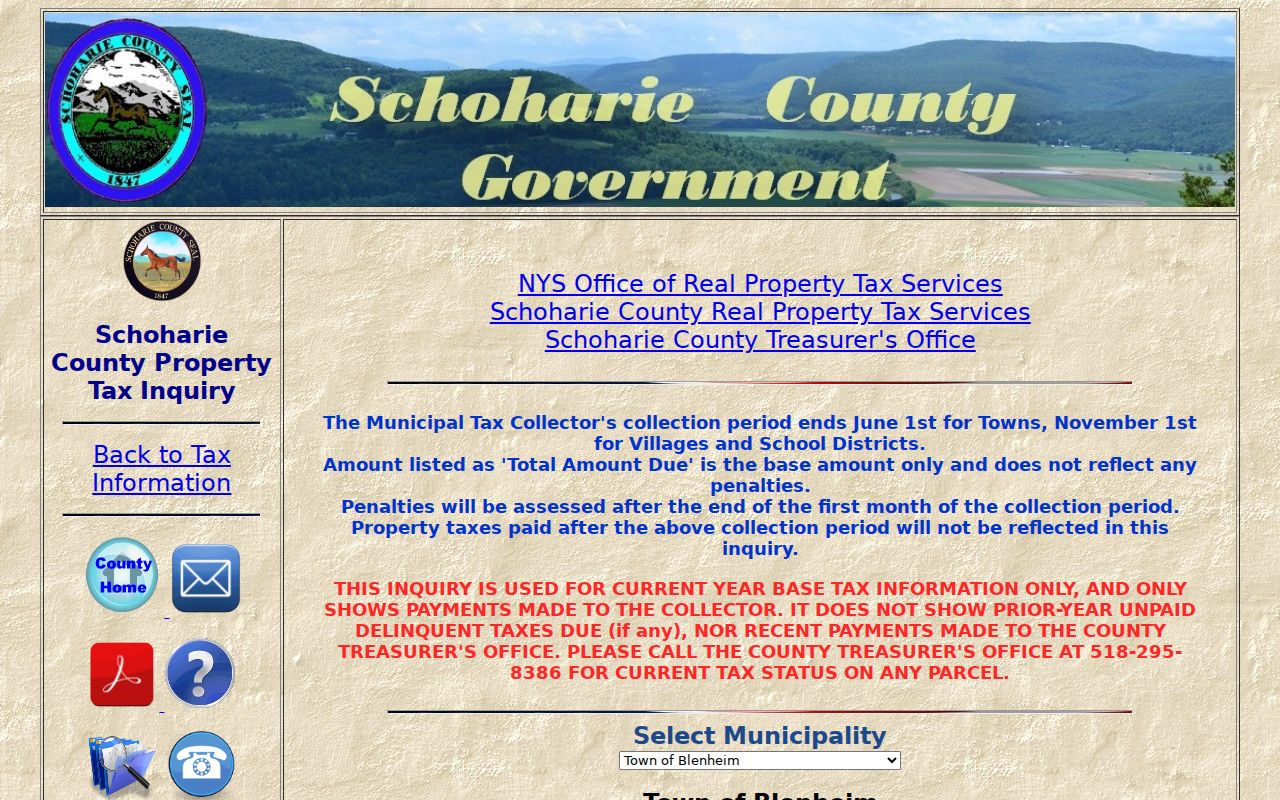
The official page displays the public search route and its limits, not proof that any particular bill is paid.
Assessment Rolls from 2005 Forward
A public selector offers town and village assessment and tax-roll PDFs. It covers 2005 to the present. Each final roll can carry a lot of detail. Expect the owner and mailing address, property class, school district, acreage, and deed book and page. You will also find land and total assessment, a full-market estimate, exemption codes, and taxable values by jurisdiction. Cite the page, municipality, roll type, and year whenever you pull a figure.
Raw assessed values do not compare cleanly across municipalities. You need the level of assessment or equalization context first. The 2024 Village of Cobleskill roll, for instance, lists a 54.80 uniform percentage. That figure belongs to that roll alone. It cannot be applied to another town or year without support.
Schoharie County's Assessment Calendar
Tax-roll activity for towns and the county begins in January. Village rolls apply in Cobleskill, Middleburgh, and Schoharie. March 1 marks the taxable-status and exemption deadline. May 1 is the tentative-roll date. Grievance Day follows, generally the fourth Tuesday in May, with local exceptions. July 1 sets both the valuation date and the final roll. September 1 brings the school roll. The county calendar and assessor directory explain the dates shown in this image.
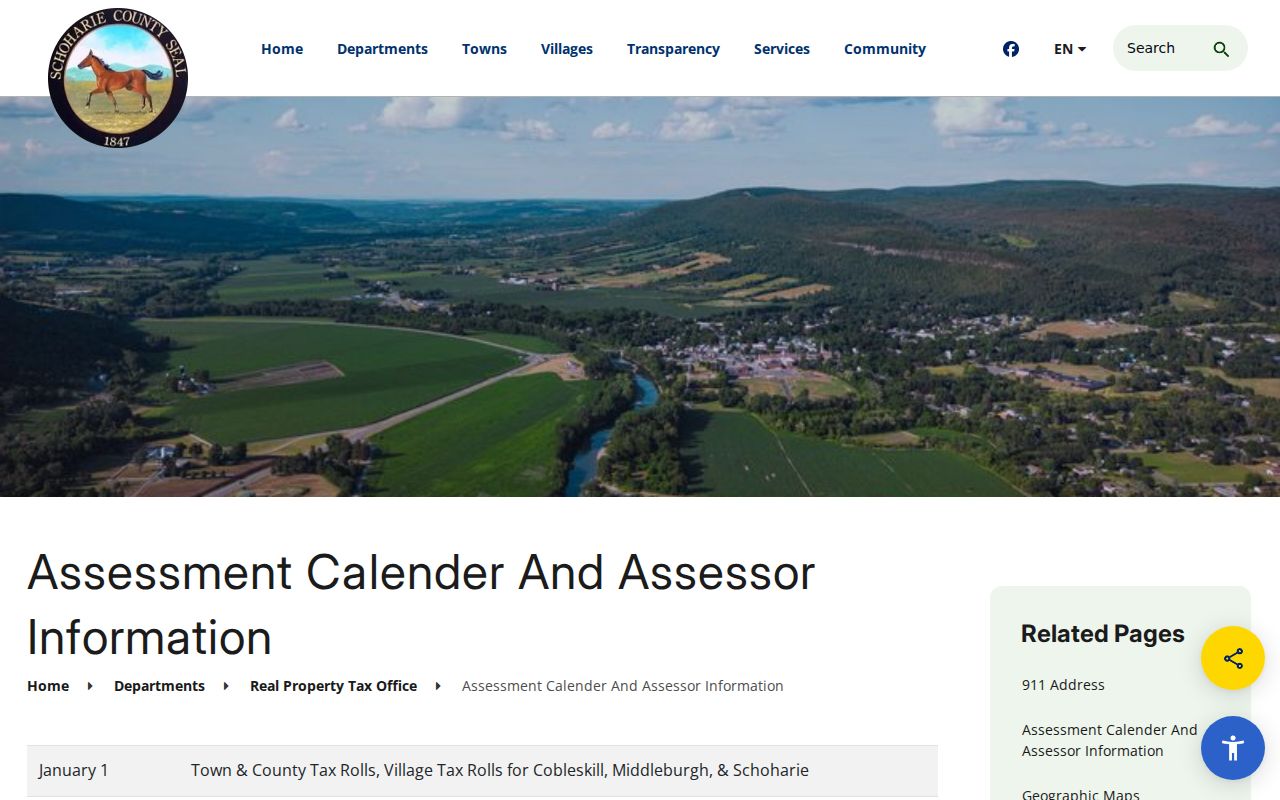
The calendar places each parcel value in its proper annual stage and points to the municipal assessor for parcel questions.
Values, Exemptions, and Taxable Columns
Four figures on a roll get confused constantly. Land assessment, total assessment, full-market estimate, and taxable value are separate fields with separate meanings. Exemptions land differently across county, town, school, fire, village, and special-district columns. Agricultural-district and school-district entries carry real context. Keep the exemption code and its matching column. Do not shrink the roll to one number.
An assessment level states assessed value as a share of market value. An equalization rate helps compare separate assessing units. Neither one is a parcel appraisal. Recorded deed consideration can add sale evidence. Yet it also needs context, and it never replaces the roll's own valuation fields.
Historical Tax Comparison without Overclaiming
Building a history takes consecutive rolls of the same type, one row per year. Log the assessment, full-market estimate, and exemptions. Add taxable values, property class, acreage, owner field, and deed reference each time. Then check deeds, maps, and permit records for an event that explains a change. Something visible in imagery stays a clue until a dated record backs it up.
Status language matters too. Say a bill or payment entry was displayed as of a retrieval date. Never claim taxes are paid just because no balance appeared on a current-year-only screen. That screen may be incomplete.
Questions for the Assessor, Collector, or Treasurer
Each office answers a different question. Ask the assessor about parcel classification, roll corrections, exemption treatment, and assessment dates. Ask the collector about recent receipts and bill delivery. The Treasurer keeps county-level status. Provide the SBL, municipality, tax year, bill number if known, and a precise status question, so the reply does not mix assessment with collection.
Tax records are dated evidence. Confirm payment status with the responsible office and keep assessment, market estimate, and taxable value separate.
What Schoharie County Property Tax Records Show
| Field | What It Shows | Where |
|---|---|---|
| Assessed value | ||
| Market / appraised value | ||
| Exemptions | ||
| Tax bill & status | ||
| Taxing districts |
Looking Up a Schoharie County Tax Bill
- by address or parcel]
- Assessed value
- Mill rate / levy
- Homestead exemption
- Tax lien
Appealing a Schoharie County Assessment
Appeal window. with the ; missing the window means waiting for the next cycle.]